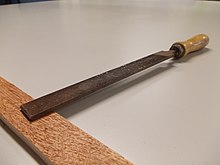
With most files, tooth size is proportional to tool length; Alternately, coarse files have larger teeth with fewer teeth per inch These larger teeth remove more material per stroke and therefore cut material quickly Typically there are three levels of coarseness bastard (coarsest), secondcut (medium), and smooth (finest) Along with the size of the tooth is the pattern of the teethTeeth with respect to the coarseness (bastard, secondcut and smooth) A singlecut file has a single set of parallel, diagonal rows of teeth Singlecut files are often used with light pressure to produce a smooth surface finish or to put a keen edge on knives, shears or saws A doublecut file has two sets of diagonal rows of teethThe second set of teeth is cut in the opposite diagonal
File Tool Wikipedia